


Mylar Bag Size Chart: A Guide to Choose the Right One
Mylar bags are not just a packaging, but a careful decision to protect the product. The quality of mylar directly influences food quality. Mylar is a flexible packaging that governs the internal microenvironment. This directly determines how effectively external factors are kept at bay from the product, such as oxygen and moisture. Incorrect sizing has additional headspace and mechanical stress, both of which degrade packaging performance.
From a commercial standpoint, an improper size of the packaging leads to material cost and compromised shelf presentation. From a technical point of view, improper mylar bag sizes reduce the efficiency of oxygen absorbers and barrier equilibrium. That is why it is important to select a proper size of the bags for a data-driven approach that will integrate a volumetric calculator with product density and intended storage duration.
In modern packaging ecosystems, brands must align Mylar dimensions with:
- Logistics optimization
- Sustainability targets
- Consumer usability
A precise size of the packaging transforms Mylars from a simple pouch into a controlled and preservative packaging that gives maximum performance.
Material Science Behind Mylar and Size Relevance
Mylar is a biaxially-oriented polyethylene terephthalate polymer that is manufactured via directional engineering to enhance tensile strength and barrier properties. The molecular alignment of the material is achieved via biaxial orientation, which improves the durability. This ultimately makes the sizes of mylar bags predictable and reliable.
The size of the bags impacts barrier properties that define the air-to-product ratio. When the size is unnecessarily large, the oxygen absorbers fail to work properly. On the other hand, a fitted bag optimizes oxygen displacement and enhances the shelf life.
Material thickness and size determine the resistance against puncture and flex cracking. For example, a large mylar bag size needs thicker mils to prevent seam stress. Smaller bags will need fewer mils and still be able to maintain the integrity of sensitive products. The correct size ensures that the inherent properties of BoPET are fully utilized, such as
- Gas impermeability
- Chemical inertness
- Mechanical strength
Classification of Mylar Bag Sizes by Application
Each category of mylar bags addresses distinct packaging challenges and operational requirements. You can categorize the mylar bag size chart into:
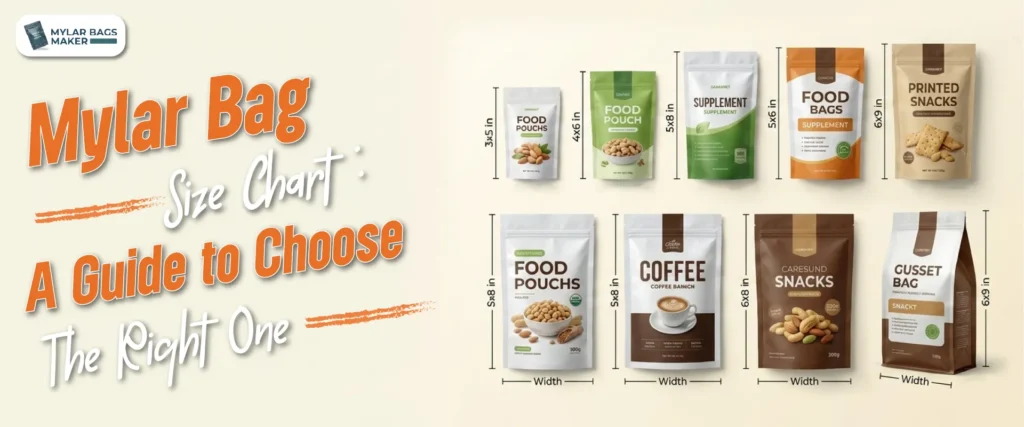
- Micro sizes of the bags are required when a minimum size and maximum protection are required. These are 2×3 to 3×4 inches in size
- Small sizes of mylar cater to consumers’ portions and high-value products. They have 3×5 to 6×9 inches sizes
- Medium sizes serve retail packaging needs with balanced capacity and usability. You can select them from the size range of 8×10 to 10×12 inches
- Large sizes are designed for bulk food storage and supply chain efficiency. 12×16 to 20×24 inches is the size of industrial mylars
By understanding bag classification, businesses can align their packaging dimensions with product lifecycles. Such as from sampling to bulk distribution. You can also simplify the inventory management and standardization across multiple stock-keeping units. This will reduce operational complexity while maintaining performance consistency.
| Category | Size | Function | Oxygen Control | Barrier Level | Thickness | Use | Benefit |
| Small Bags | 3×4–6×9 | Precision Storage | Rapid Reduction | High Barrier | 3–5 mil | Herbs Packaging | Freshness Retention |
| Medium Bags | 8×10–10×12 | Retail Packaging | Balanced Control | Durable Barrier | 4–6 mil | Consumer Goods | Shelf Appeal |
| Large Bags | 12×16–20×30 | Bulk Storage | Controlled Environment | Strong Barrier | 6–7 mil | Grain Storage | Volume Efficiency |
| Extra-Large Bags | 24×36+ | Industrial Storage | Advanced Control | Maximum Barrier | 7–12 mil | Food Security | Long-Term Storage |
Impact of Size on Oxygen Control
Oxygen control is an important feature of mylars, and it is impacted by the size. The size will determine the oxygen levels in the bags. Large bags will have more residual oxygen, which can increase the oxygen load. For the maintenance of product quality, packaging must be able to control that oxygen load.
For this, oxygen absorbers are used that have specific capacities. If you choose too large bags, you will lose the capacity of oxygen absorbers. The right-sized bags will allow an optimal oxygen absorber performance, which will create a near-zero oxygen environment. This way, you can reduce spending on oxygen absorbers and simplify the packaging process to enhance the shelf life of packed items.
Headspace Optimization in Mylar Bags
The empty space between the product and the seal of the mylar bags is called headspace. This needs proper management to achieve effective elimination and oxygen control. Excessive size increases oxygen volume and insufficient head space that makes sealing difficult. This will also compromise the quality of your product. The ideal space is 1 to 2 inches, as this allows efficient heat sealing without the addition of excess air. The right size will reduce packaging cost and enhance packaging aesthetics.
Thickness vs Size: Structural Relationship
Thickness and the size of the bags are interdependent variables in mylar bags. As the size increases, the thickness should also. This will maintain structural integrity and reduce mechanical stress. Thicker films provide the necessary strength to prevent tearing and seam failure. Always meet the minimum durability to retain product quality.
Volume Calculation for Accurate Sizing
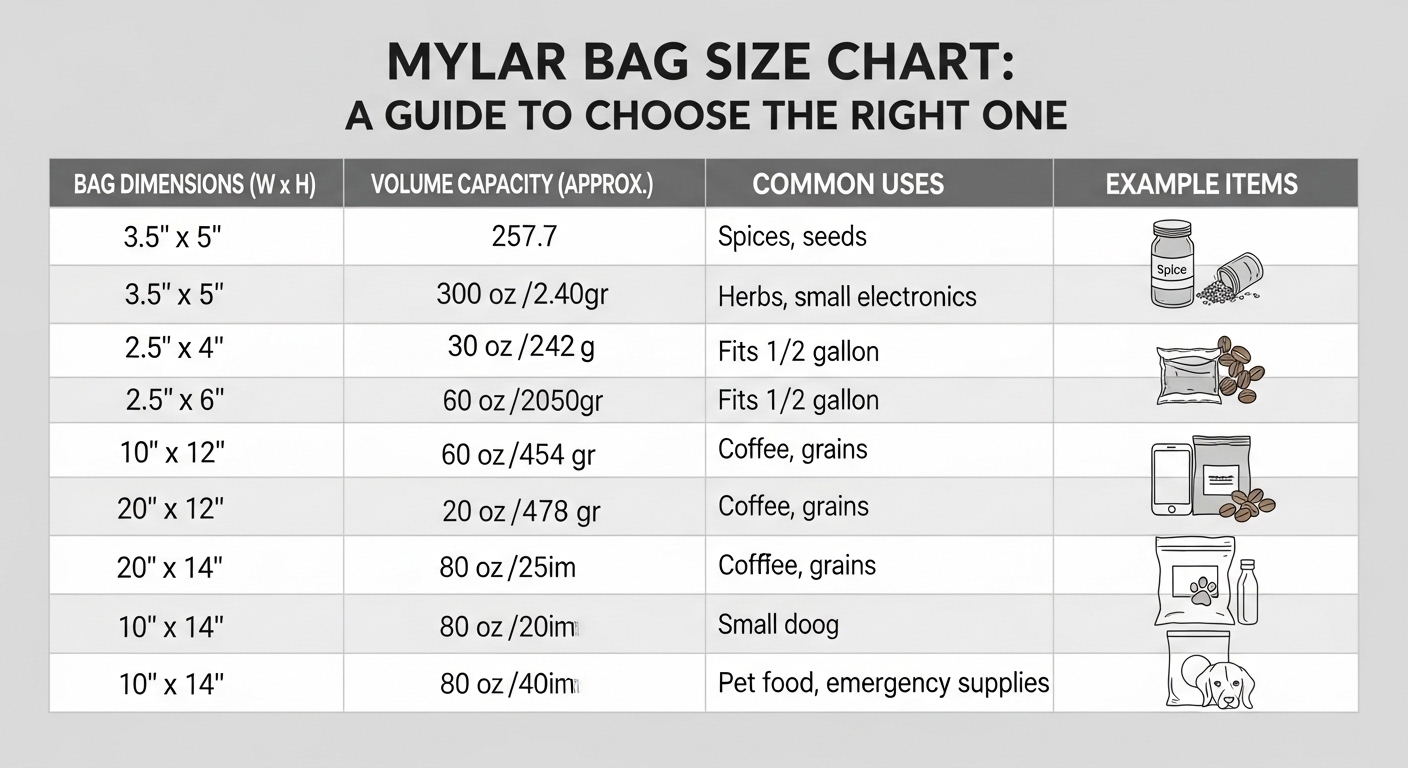
You must also consider the volume of the product. Unlike weight, volume determines the right mylar bag dimensions. Length and width, along with depth, are used to determine the volume of mylar. Always test with sample mylars to validate the calculations.
Product Density and Size Selection
Product density is another very important factor that determines the size. Dense products need less volume than lightweight products such as rice and flour. If you ignore product density, you may end up selecting overfilled or underfilled custom food pouches. Different products with the same weight may require different bag sizes due to variations in density. This highlights the importance of product-specific analysis.
Above, we have discussed the general overview of Mylar bag sizes based on product volume and other aspects. Now we will do an in-depth study of the bags based on numerical calculations.
1 Gram (3×4 Inch Mylar Bag): Micro-Packaging Precision Unit
The 3 into 4-inch mylar bag represents the smallest standardized format of flexible packaging. This size of mylar is used for ultra-low volume applications where precision and isolation from the environment are essential. The inhaled space is limited, so minimal oxygen absorbers are required. These bags have 3 to 5 mil of thickness that balances flexibility with sufficient puncture resistance. The common applications of these custom pouches are:
- Sampling
- Trial packs
- High-value low-volume goods
- To test new SKUs
- Distribution of promotional samples
3.5 Grams (3.5×5 Inch Mylar Bag): Controlled Expansion Format
The 3.5 into 5inch Mylar bags introduce a slight increase in volumetric capacity. This allows improved product accommodation that requires minor expansion or airflow during packing. Products that are lightweight but volumetrically larger can be placed in custom 3.5 Mylar bags. Brands can reduce the risk of seal stress and have low internal air volume. The common application of 3.5 gram bags to oz of product packaging is as follows:
- Premium samples
- Nutraceutical portions
- Specialty food items
- Herbs
- Fragile botanical
- Crystalline materials
3. 7 Grams (4×6 Inch Mylar Bag): Small Retail Entry Format
The 4 by 6-inch mylar packaging bags are frequently used in retail environments. This bag provides sufficient internal volume that accommodates products without excessive compression. 3. 7 grams size of the bags reduce localized pressure points and the liability of product damage. You can pack irregularly shaped products, such as:
- Dried fruits or herbal blends
- TeaS
- spices
- Snack
Cannabis mylar bags commonly have this size. From a barrier standpoint, the 4×6 format maintains high efficiency due to its moderate headspace. Oxygen absorbers can easily create a low-oxygen environment, extending shelf life for perishable dry goods.
14 Grams (5×8 Inch Mylar Bag): Structural Stability Format
A 5 into an 8-inch bag is manufactured with enhanced net space. It does not transition into bulk packaging and is suitable for semi-fragile products. Some of the brands ponder over “how big is an 8-oz bag?” so the average size of this bag is 5 to 8 inches. The large surface area distributes the internal space evenly and reduces the likelihood of seam failure. The following are the applications of these bags of a certain size:
- Dried foods
- Granola
- Larger botanical materials
Some of the other sizes of custom printed mylar bags are as follows:
| Size Format | Usage Type | Barrier Function | Structural Feature | Commercial Benefit |
| Standard Format | Multi Use | Oxygen Control | Balanced Structure | Cost Efficiency |
| Entry Bulk | Bulk Storage | Barrier Performance | Thick Material | Retail Storage |
| Retail Bulk | Bulk Packaging | Volume Control | Gusset Support | Visual Appeal |
| Full Storage | Bulk Transport | Oxygen Management | High Thickness | Long Storage |
Conclusion!
The selection of mylar bag sizes is a critical thing that influences the packaging quality and cost efficiency. A systematic approach to packaging ensures optimal results across all applications. From product volume to design, all are important factors to consider while selecting the size, so you do not have to bear extra packaging costs. For a right packaging service, you can contact Mylar Bags Makers in Canada.