

The Complete Guide To Mylar Bag Materials
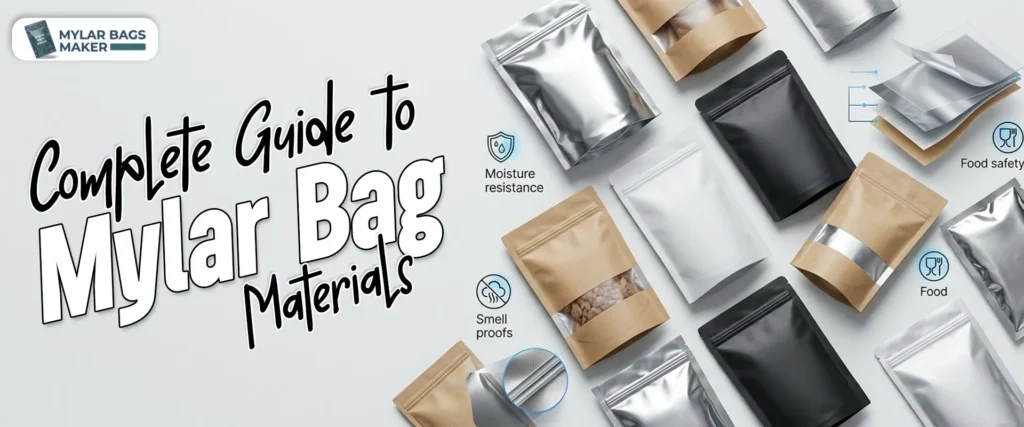
If you wonder what common Mylar bag materials keep the food fresh for 25 years and what fails to do so, then you are asking the right question. The answer lies entirely in the material used to manufacture the bags. This selection depends on the nature of the product and the required storage duration.
In this blog, we will break down:
- Everything you need to know about mylar bags
- Every material used in modern Mylar bag manufacturing
- What each one does
- Which combination of materials is right for your specific application
- Emergency food storage and commercial food packaging material differences
- Pharmaceutical containment or sustainable product packaging material options
What Is a Mylar Bag?
The term “Mylar” is widely misused in the packaging industry. Mylar is a brand name for a specific type of polyester film named BoPET. This polyester was originally developed by DuPont. Mylar bag has become a catch-all term for any multi-layer laminated flexible packaging that provides high barrier protection against oxygen to moisture and light.
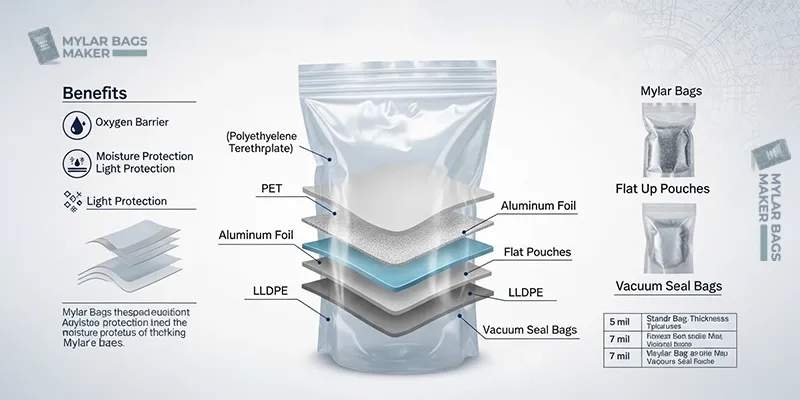
The main thing there is multi-layer. A high-quality printed Mylar bag is not a single material. It’s an engineered laminate of two to five distinct materials. Each material is chosen for a specific functional role. The first step to becoming an informed buyer depends on understanding these layers.
Core Mylar Bag Materials
The multiple layers of mylar manufacture the packaging to give an alluring and durable product protection. Each layer has a different role and a different strength. The combination of these multiple layers results in a packaging that gives years of shelf life to the packed items.
Polyethylene Terephthalate
This is the foundation layer that gives flexible packaging. PET material is strong and glossy, which makes it inherently moisture-resistant. The outer layer of mylar bag is manufactured with PET. When you hold a food storage bag and feel that firm and crinkly exterior, you’re touching PET.
Why It Matters
PET provides dimensional stability, which means the bag holds its shape under stress. It also has excellent printability, which is why you see crisp and photorealistic graphics on premium packaging. PET is FDA-approved for direct and indirect food contact, and it withstands temperatures from – 70°C to +150°C. This makes it compatible with freezer storage and mild heat processing. Custom food mylar bags are manufactured with this material.
Metallized PET
This material is the barrier powerhouse that is applied via vapour deposition to the PET material. Metallized PET material has a thin layer of aluminum that gives mylars their defining protective ability against three elements:
- Light
- Oxygen
- Moisture vapor
Metallized PET remains flexible and lightweight, and reduces the oxygen transmission and water vapor transmission rate quite low. This keeps the packed items safe for years.
Why It Matters
A bag without aluminum foil as a substitute is not a true long-term storage bag. This is because the other materials do not have the ability to reduce oxygen and moisture transmission. The middle or inner-adjacent layer in food storage, and custom smell-proof mylar bags have this moisture-barrier layer.
Polyethylene
This is the heat-sealing layer that holds everything together. PE is a soft and Flexible inner sealing layer that offers durability and heat-sealing properties. It slightly melts to create an airtight seal when you press the bags closed with a heat sealer. PE is food-safe and resistant to most chemicals. That is why it gives a good moisture barrier. Low-density PE is soft and flexible. High-density PE is stiffer and stronger. Most Mylar bag inner layers use LDPE or its linear variant.
Why It Matters
Poor-quality PE or improper sealing temperatures result in weak seals that fail the purpose of long-term storage. Custom heat-sealed mylar bags have these materials as an inner layer.
Linear Low-Density Polyethylene
This layer can be known as the puncture fighter. LLDE is a structurally modified version of the PE. This material has a unique structure that gives puncture resistance and elongation. Which means that this material stretches on contact and does not split.
For food storage applications with sharp-edged products, this material is used like pasta or freeze-dried vegetables with crispy edges. It does not give micro tears to the packaging that can damage the oxygen barrier.
Why It Matters
Micro-punctures are invisible to the naked eye but catastrophic for long-term storage. LLDPE dramatically reduces this failure mode. The common use of this material is in custom food pouches for sharp or abrasive products.
Aluminum Foil
This material provides maximum protection and can be used in place of metallized PET. While metallized films achieve excellent oxygen and moisture resistance, laminated aluminum foil achieves near-total impermeability. The oxygen transmission rate value is zero for this material.
Foil-laminate bags are heavier and more rigid than their metallized-film counterparts, but they are the gold standard for products requiring shelf lives of 10 to 30 years, such as:
- Military rations
- Emergency food reserves
- Pharmaceutical packaging
- High-value electronics
Why It Matters
If you’re storing food for genuine long-term emergency preparedness, aluminum foil laminates are not optional but a necessity. Smell-proof and cannabis mylar bags are manufactured with these materials.
Biaxially Oriented Polypropylene
These layers are mandatory for clarity and print quality. BOPP is oriented in two directions during manufacturing, which gives it exceptional optical clarity and surface smoothness. It’s lighter than PET and offers excellent printability. Brands that want vibrant and high-resolution graphics on their packaging often specify BOPP as the outer layer.
Why It Matters
This layer is commonly used in retail packaging where print quality is required. It is commonly used as snack packaging, such as candy mylar bags.
Kraft Paper
This is becoming popular day by day in flexible packaging due to consumer demands. Kraft paper is sustainable and used as an outer layer on conventional mylar. Kraft mylar bags have a matte and tactile appearance.
Why It Matters
For brands targeting environmentally conscious consumers or natural/organic product categories, kraft exteriors significantly influence purchasing behaviour. Custom coffee and custom exotic mylar bags usually have kraft as an outer layer.
Polylactic Acid
This material is derived from fermented starch plants, which are most of the time sugarcane. Polylactic acid is a compostable bioplastic that is widely used in commercial packaging. The best part about this plastic is that it decomposes in 90 to 180 days. It has less heat resistance, and its barrier properties are also lower than those of traditional plastic packaging.
Why It Matters
PLA is the most significant development in sustainable flexible packaging. The common application of this material is in Mylar bags that are used for a short duration, such as custom sprinkled Mylar bags.
Nylon Or Polyamide
It has remarkable puncture resistance and is lighter and more rigid than polyethylene. Brands select this material for outstanding resistance to abrasion and gases. Nylon is the best option when vacuum seal packaging is required. It maintains structural integrity under the stress of vacuum compression without developing pinholes.
Why It Matters
For vacuum-sealing applications, nylon is non-negotiable. It is used as a middle or outer layer of vacuum seal Mylar bags.
Ethylene Vinyl Alcohol
This is the highest-performance oxygen barrier material available in flexible packaging. Ethylene vinyl alcohol has a low oxygen transmission rate, and it can be used in a thin layer. The only negative thing about this material is its moisture sensitivity. It must be used between moisture-resistant layers to get durable Mylar.
Why It Matters
Products that need protection from oxygen are packed in ethylene vinyl alcohol mylar, such as oils and sauces. It has a protective ability that makes it a good option for cannabis mylar bags.
How to Choose the Right Material Combination
The selection of material depends on the duration of storage and the type of product you need to pack. Every aspect of the packaging is considered to identify which material is the best. Make sure that the size and the style both align with the material, so you do not have to face any issues. For the understanding of sizes, you can read our mylar bag size chart: a guide to choose the right one. Follow the table below for a summary of material selection:
| Product Type | Barrier Need | Storage Duration | Material Structure | Industry Usage |
| Dry Snacks | Moisture Shield | Short Storage | PET Layer | Retail Foods |
| Coffee Beans | Aroma Barrier | Medium Storage | Kraft PET | Organic Brands |
| Freeze Meals | Oxygen Block | Long Storage | Foil Laminate | Emergency Supplies |
| Herbal Products | Smell Control | Medium Storage | Metallized PET | Cannabis Packaging |
| Liquid Sauces | Oxygen Defense | Short Storage | EVOH Barrier | Sauce Packaging |
| Sharp Pasta | Puncture Guard | Long Storage | LLDPE Layer | Dry Foods |
| Vacuum Meats | Vacuum Strength | Medium Storage | Nylon Laminate | Meat Packaging |
| Pharma Tablets | Chemical Resistance | Long Storage | Foil Nylon | Pharmaceutical Storage |
| Baby Snacks | Food Safety | Short Storage | PLA Laminate | Eco Packaging |
| Electronic Parts | Static Protection | Long Storage | Foil PET | Electronics Storage |
Whether you are a food manufacturer or you are running a retail brand, mylar bags are essential. Understand the quality and effectiveness of different materials used to manufacture Mylar to get the maximum benefits. Have questions about Mylar bag specifications for your product? The right material stack depends on your shelf-life target and storage conditions. Consult a certified packaging expert and reach out to Mylar Bags Maker in Canada, a reputable flexible packaging supplier.